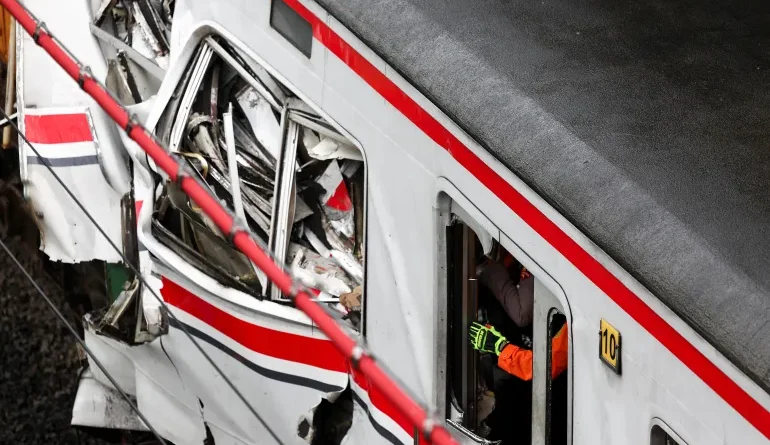
train crash near Indonesia’s Jakarta rises to 14
A devastating train collision near Jakarta, Indonesia, has left at least 14 people dead and more than 80 injured after two trains crashed near Bekasi, a city adjoining the capital. Rescue teams have been working through the wreckage to reach trapped passengers, with emergency crews describing the operation as difficult due to crushed carriages and limited access points.
The crash occurred late Monday night at or near Bekasi Timur Station in Bekasi, West Java, involving a commuter train and a long-distance service. Early reports indicate the commuter train was stopped on the tracks when it was struck by the oncoming long-distance train. Authorities later confirmed that the death toll rose as rescuers continued to extract victims from heavily damaged compartments.
Officials from Indonesia’s state railway company, Kereta Api Indonesia (KAI), said at least 84 people were transported for medical treatment following the collision. Rescue workers from Indonesia’s National Search and Rescue Agency (BASARNAS) used cutting equipment to free passengers trapped inside mangled train cars, moving carefully to avoid further injury to survivors still pinned in the debris.
Bekasi, located just east of Jakarta, became the center of a large emergency response as ambulances, police, and rescue crews flooded the scene. Investigators believe a chain of events may have contributed to the collision, including reports that a taxi became involved at a nearby rail crossing, causing the commuter train to stop before being struck by the long-distance train. Authorities are continuing to investigate the exact sequence of events.
Among the trains involved was the premium long-distance service known as the Argo Bromo Anggrek, which operates between Jakarta and Surabaya. Reports indicate that the most severe damage occurred in the rear section of the commuter train, where passengers became trapped following the impact.
Authorities continue to assess the full scale of the tragedy while Indonesia’s transportation safety officials investigate possible causes, including infrastructure conditions, signaling systems, and operational procedures. The collision has renewed public concern about rail safety and the challenges posed by heavily congested rail corridors in the Jakarta metropolitan region.